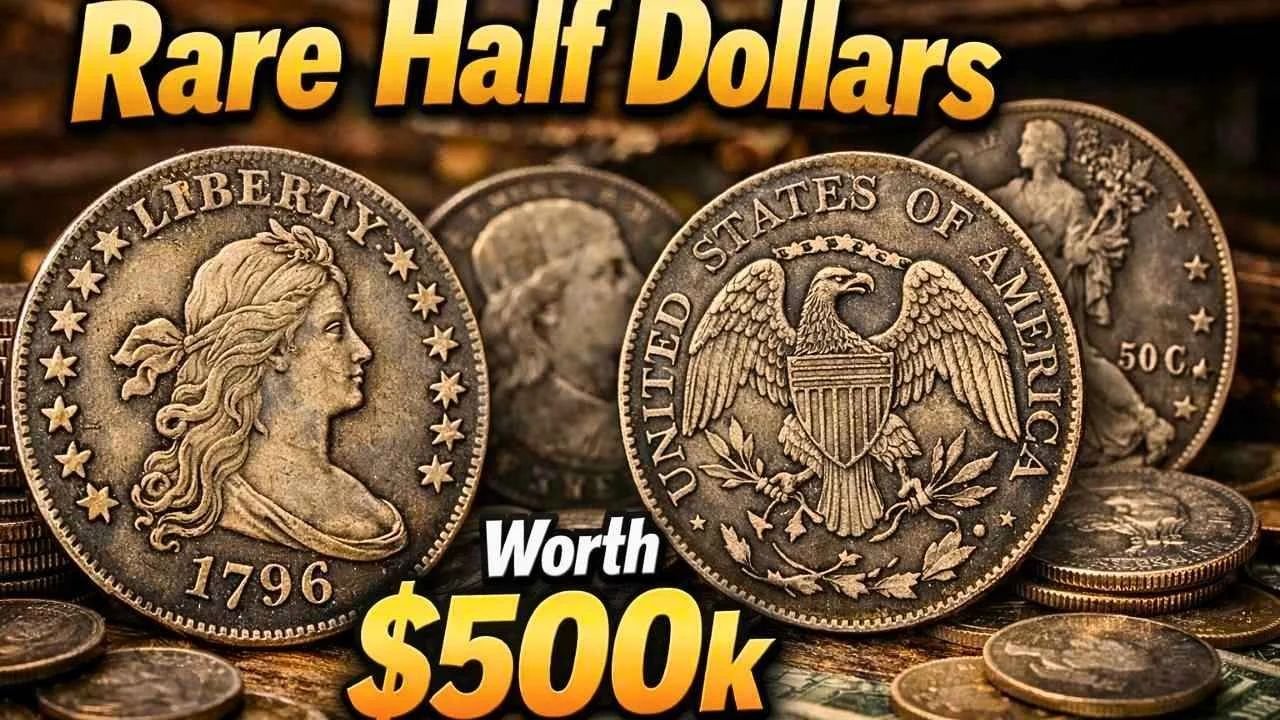
Half dollars rarely make headlines. Most sit quietly in collections or circulate at face value. But a select few have reached astonishing prices at major auctions, with top examples approaching—or exceeding—$500,000 in today’s elite numismatic market.
For serious collectors and investors, these coins are more than metal. They represent pivotal moments in American history, limited mintages, and extraordinary preservation. Here’s a closer look at five legendary half dollars commanding six-figure attention right now.
The Enduring Appeal of the Half Dollar
First struck in 1794, the half dollar quickly became a cornerstone of early U.S. commerce. Over time, its designs evolved, reflecting changing artistic styles and national milestones.
From early federal coinage to 20th-century commemorative issues, the denomination has consistently attracted collectors drawn to its larger canvas and detailed engravings.
The 5 Half Dollars Making Headlines
| Coin | Key Feature | Why It’s Valuable | Top Market Range* |
|---|---|---|---|
| 1794 Flowing Hair | First-year issue | Historic significance, extremely scarce | $400,000–$500,000+ |
| 1838-O Capped Bust | New Orleans debut | Very low surviving examples | Up to $500,000 |
| 1916 Walking Liberty (High Grade) | Early issue rarity | Scarce in Mint State | Six figures+ |
| 1964 Kennedy Special Strike | Unique finish | Limited production, historic year | Up to $500,000 |
| 1870-S Seated Liberty | Major rarity | Few confirmed examples | $400,000+ |
*Values depend heavily on grade, certification, and auction demand.
The Elite Five Explained
1794 Flowing Hair Half Dollar
The 1794 Flowing Hair half dollar marks the beginning of the denomination. As one of the earliest silver coins struck by the young U.S. Mint, it carries enormous historical weight.
High-grade survivors are exceptionally rare. When well-preserved examples surface, competitive bidding often pushes prices toward the half-million-dollar mark.
1838-O Capped Bust Half Dollar
The 1838-O Capped Bust half dollar represents the first year of half dollar production at the New Orleans Mint.
Only a small number are known to exist today. That combination of regional history and rarity has cemented its place among the most desirable early branch-mint issues.
1916 Walking Liberty Half Dollar
Collectors widely regard the 1916 Walking Liberty half dollar as one of the most beautiful U.S. coin designs ever produced.
While circulated pieces are accessible, sharply struck Mint State examples are far more elusive. In top condition, they can command impressive six-figure prices, particularly when certified at the highest levels.
1964 Kennedy Half Dollar Special Strike
The 1964 Kennedy half dollar Special Strike stands apart from standard circulation coins of the same year.
Produced under unusual circumstances and in extremely limited numbers, these special strike pieces feature distinctive finishes. Their historical connection to President Kennedy’s memorial coinage further strengthens collector demand.
1870-S Seated Liberty Half Dollar
Among serious numismatists, the 1870-S Seated Liberty half dollar is considered a trophy coin.
With only a handful of confirmed examples, scarcity drives its value. Whenever one appears at a major auction, it generates immediate national attention within the collecting community.
Why Prices Reach $500,000
Four factors typically separate a valuable half dollar from a record-breaker:
Scarcity
Low original mintages—or extremely small surviving populations—create intense competition.
Condition
Coins graded near Mint State (MS-65 and above) by respected services can multiply in value compared to circulated pieces.
Historical Importance
First-year issues, branch mint debuts, and coins tied to national events draw stronger interest.
Provenance
A well-documented ownership history often increases buyer confidence and final sale prices.
Market Momentum in 2026
Rare U.S. coins continue to show resilience in the collectibles market. Auction houses report sustained demand for trophy-level pieces, particularly those with certified high grades and strong eye appeal.
While not every half dollar is a hidden fortune, these five examples prove that exceptional rarity and preservation can transform a 50-cent coin into a six-figure asset.
Protecting High-Value Coins
Proper storage is essential. Collectors rely on certified holders, climate-controlled environments, and careful handling to preserve surfaces.
Cleaning or altering a coin can permanently reduce its value. For rare pieces, professional conservation is the safest path.
A Legacy That Endures
Half dollars reflect more than monetary history. They capture artistic evolution, regional mint expansion, and moments that shaped the nation.
For collectors fortunate enough to own one of these elite issues, the reward extends beyond financial value. It’s a tangible link to America’s earliest coinage—and a reminder that extraordinary treasures can still exist within a familiar denomination.